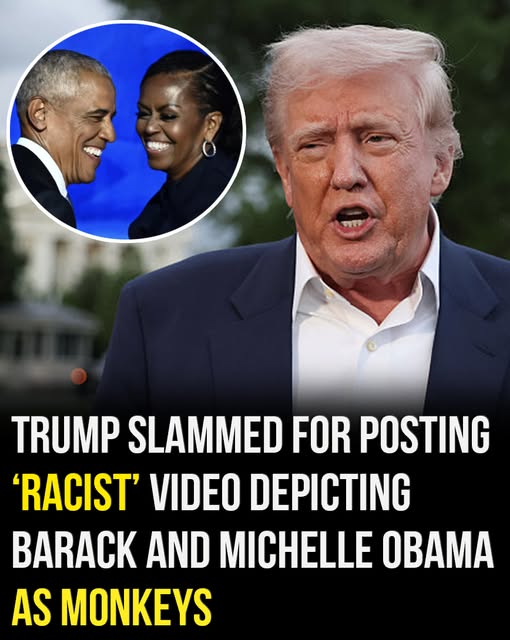
The political landscape in the United States has been thrust into a renewed state of volatility following a controversial social media post by Donald Trump. On February 6, 2026, a video shared on the former president’s Truth Social account sparked an immediate and intense national debate, drawing widespread condemnation for its use of imagery that many have categorized as overtly racist. The clip, which lasted approximately one minute, primarily focused on the recurring and legally rejected claims regarding the 2020 presidential election. However, it was a brief, two-second segment toward the conclusion of the video that ignited a firestorm: an animation depicting former President Barack Obama and former First Lady Michelle Obama with their faces superimposed onto the bodies of monkeys.
The imagery, set to the rhythmic cadence of the song “The Lion Sleeps Tonight,” immediately bypassed the standard partisan bickering to touch a raw nerve in the American psyche. For historians, sociologists, and civil rights advocates, the comparison of Black individuals to primates is not merely an insult but a deeply rooted racist trope used for centuries to dehumanize and marginalize Black people. Critics argue that such imagery, when disseminated by a figure of Trump’s stature, transcends simple political satire and enters the realm of systemic harm.
The backlash was swift and multi-faceted, cutting across political lines while highlighting the deep fissures in the country’s social fabric. California Governor Gavin Newsom’s office released a sharp rebuke, characterizing the post as “disgusting behavior” and challenging Republican leadership to distance themselves from the rhetoric. Political strategists and commentators echoed these sentiments, with many arguing that the intent behind the imagery was unmistakable. Adam Parkhomenko, a prominent political strategist, noted that the brevity of the segment did not diminish its impact, suggesting that the choice of animated characters was a deliberate attempt to utilize historical prejudice under the guise of online meme culture.
On social media, the reaction served as a microcosm of the national divide. Truth Social, the platform where the video originated, saw a surge in engagement, with the post garnering tens of thousands of likes and shares within hours of its release. While many users defended the post as a “Lion King” themed parody intended to frame Trump as the rightful “King of the Jungle” and his political rivals as secondary jungle characters, others expressed profound disillusionment. Some users, identifying as former Trump voters, voiced regret, stating that the use of such racially charged tropes made it impossible to support the former president’s platform.
The White House, represented by Press Secretary Karoline Leavitt, attempted to neutralize the controversy by framing it as a misunderstanding of internet subculture. Leavitt characterized the outcry as “fake outrage,” suggesting that the video was a harmless meme meant to be a humorous commentary on political dynamics. The administration’s stance was that the public’s focus should remain on pressing national issues rather than a fleeting digital animation. This defense, however, did little to appease those who pointed out that memes do not exist in a vacuum and that the selection of primates specifically for the Obamas carried historical baggage that cannot be easily dismissed as accidental.
This incident is part of a broader, more frenetic period of communication from Trump, who reportedly made over 60 posts within a three-hour window on the same day. This digital blitz included everything from renewed attacks on Dominion Voting Systems and promotion for an upcoming Super Bowl advertisement to a suggestion that his likeness be added to Mount Rushmore. The sheer volume of content often serves to dilute the impact of individual controversies, but the “monkey” imagery has proven to have a longer shelf life due to its visceral nature.