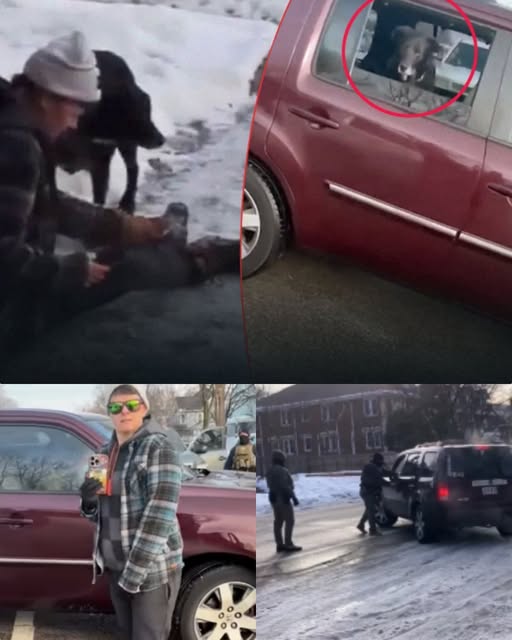
Snow lay thick over the quiet street, powder white and still, as though the world had paused itself against the cold. It was a morning that felt suspended outside time — where breath crystallized in the air, and each small sound seemed muffled by the blanket of snow. In the back seat of the car, a loyal dog watched the drifting flakes settle like feathers on the ground. The dog did not bark. It did not whine. It simply peered out the open window, ears slightly raised, confused by the tension that hung heavy in the air.
Inside that car sat Renee Nicole Good, calm and composed as always — or at least as composed as she could be amid the rising swirl of voices. Her breath fogged the edges of the window as she breathed slowly, trying to make sense of the raised tones and the thick tension that wrapped around every word spoken near her vehicle. She had dropped her young son at school only moments earlier, kissed him on the cheek, and waved him into the classroom unaware that this day — this ordinary snowy morning — would become the darkest of their lives.
Renee was known to those closest to her not as someone easily rattled, but as someone whose calm steadied others. A gentle voice in anxious rooms. A warm presence in hard places. She spoke softly, even when circumstances pushed others to anger. Her wife,
Becca, often joked that Renee’s patience and poise could ease storms — even if only those inside one’s own heart.
On this morning, that inner storm was about to break worse than anyone could have imagined.
The Encounter That Changed Everything
It began simply: a routine turn onto a residential street coated in snow. Federal agents from U.S. Immigration and Customs Enforcement — ICE — had been in the area for a coordinated enforcement operation. No one in the neighborhood was taken by surprise; agents in heavy gear had been moving down nearby avenues all week, framed by press briefings and heated debate over federal enforcement nationwide.
But Renee wasn’t there to protest. She and Becca had simply been driving home. Their dog, loyal and always close, sat in the backseat.
Without warning, officers gestured for the vehicle to stop. Confusion — not defiance — marked Renee’s response. She rolled down her window, her voice calm but firm. “We’re just coming home,” she said. That kindness, that soothing presence, was her instinct — always to pacify, always to protect, always to soften what could be hard.
Yet that serene voice — the very essence of who Renee was — could not quell what was about to come.
In the flurry of calls and gestures, something shifted. The car, halted in the snowy street, became the center of a sudden swirl of tension. Orders were shouted. There was a demand to exit the vehicle. Confusion deepened.
Witnesses would later recount that, amid the snow and shouts, Renee’s SUV made a movement — a slow turn — in an attempt to reposition. But before anyone could intervene or understand, the crack of gunfire shattered the stillness. Three shots. Renee crumpled in the driver’s seat, her life taken in a moment that would ripple far beyond that frozen block.
The Silent Witness
In the backseat, the dog turned its head sharply at the sound of the shots. Snow swirled outside the window like a winter storm that would never end. But inside, time had stopped.
For a moment, the dog simply looked forward, ears still, eyes wide — as though it waited for Renee to speak, to reassure it, to explain why the world had suddenly ripped apart with noise. Loyal to the last beat of her heart, the dog did not flee. It did not bark. It stayed still, a silent witness to a moment no living thing should bear.
This same dog would later be seen curled beside Becca — who had collapsed onto the cold ground nearby — her body shaking, her heart breaking again and again. Becca blamed herself, whispering over and over,
“It was my fault.” “I asked her to come.” “Maybe if I had stopped her…” The pain of grief cast her face pale as snow itself.
And through all this, the dog stayed close — its warm body pressed near hers, an unspoken comfort in the midst of unfathomable sorrow. The loyal soul that had stood quietly in the backseat now stood guard over the ruin of a family’s world.
Renee: The Woman Beyond the Moment
To understand the depth of the loss, one must see beyond that moment and see who Renee was.
At 37, she was a mother, a poet, a wife, and a soul marked by compassion. Born and raised with a love for words and creativity, she poured her heart into poetry and the lives of her children. Her gentle humor, her empathy for others, and her beautiful singing voice were among the many things that made her beloved by those fortunate enough to know her.
She had three children — two older and one young son whom she had that morning hugged and kissed at school. Her youngest, just six years old, waited inside that classroom, unaware that his mother would not return home that day. Her oldest children, 12 and 15, would soon learn that life could deliver agony no parent should ever have to explain.
Becca, her wife, would later remember Renee not through the lens of that terrible moment, but through all the times she chose love when it was easier to choose anything else. “We had whistles,” Becca said. “They had guns.” The contrast was stark not just in words but in spirit — for Renee’s life had been one of gentleness in a world that all too often demands steel.
After the Shots: A City Reels
News of Renee’s death did not stay contained. It spread like cracked ice underfoot — unpredictable, tragic, and capable of deep rupture.
People gathered, first in quiet shock, then in rising grief and indignation. What should have been a hushed winter afternoon became the spark for demonstrations across Minneapolis and then across the nation. In snow‑packed streets and city squares, thousands marched not only in memory of Renee, but in protest of a system that had taken a life so loved and so gentle.
Protesters carried signs, voices lifted in unison and sorrow, gathering where once there had been only silence and snow. The echoes of grief filled spaces once quiet — a testament to a community’s refusal to let her memory fade. In some places, lines of chants met lines of federal officers; in others, mourners placed flowers and candles at makeshift memorials where Renee’s life had ended.
State and local leaders — shaken by events — questioned what had happened and how a life so vibrant had been extinguished in an instant. The mayor of Minneapolis called for accountability. Legal advocates and community organizers demanded transparency and justice. All the while, her children and her wife were left to gather the pieces of a life that would never be whole again.
The Echo of Loss
Months from now, when memories soften but do not fade, those who knew her will still speak her name.
They will tell stories of a mother who sang softly as she tucked her children into bed. They will speak of the way she made coffee in the morning, and how her laughter could swerve sadness into joy. They will remember her gentle hand on a stranger’s shoulder, her poems read aloud at family gatherings, her calm voice offering solace when it was most needed.
And somewhere in that remembering, there will be that loyal dog — now too old for its years by the measure of heartbreak. Still faithful. Still quiet. Still gazing out a window at skies too wide and too sorrowful.
Becca will tell her children that their mom loved them more than the winter sky loved snowflakes. That her tenderness was her gift. That her life, though cut short, was filled with warmth and connection that no darkness could ever erase.
And when they speak of her, the dog will sit by their side, silent and still — as it did that morning — a living reminder of a loyalty that endured even the cruelest break in time.