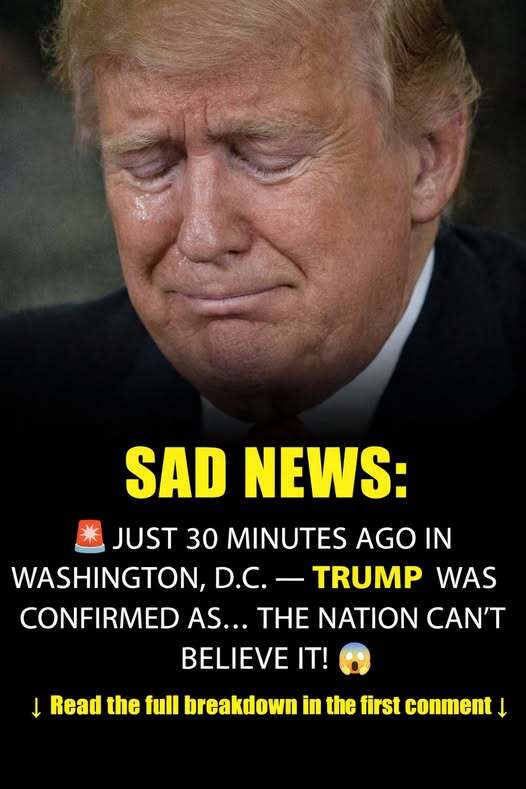
In Washington, D.C., history is often associated with spectacle. Cameras flash, statements are issued, speeches echo across marble halls, and every movement is dissected in real time. Yet some of the most revealing moments never make headlines. They happen quietly, away from podiums and press briefings, when the noise fades and reflection takes its place. It is in these moments that leadership reveals its most human dimension.
Recently, one such moment unfolded in the nation’s capital involving former President Donald Trump. It was not a rally, a court appearance, or a political announcement. There were no slogans or applause. Instead, it was a subdued moment of reflection—one that stood in sharp contrast to the public image that has followed Trump for decades. For a figure so closely associated with confidence, confrontation, and relentless visibility, this quieter presence offered a different lens through which to view leadership.
Leadership is often presented as a performance of certainty. Strength is expected. Doubt is hidden. Emotion is treated as weakness. Trump’s public career, from business to television to the presidency, reinforced that archetype. He built a brand around decisiveness and dominance, around the idea that winners never hesitate and never look back. That image resonated deeply with supporters and critics alike, shaping how he was perceived long before he entered politics.
But leadership, in reality, is not a constant display of force. It is a long, exhausting journey shaped by pressure, consequence, and responsibility. Every decision made at the highest levels carries weight far beyond the individual making it. Policies ripple outward. Words alter markets, alliances, and lives. Even when leaders project unwavering confidence, the burden of those decisions does not disappear.
The presidency, more than almost any role in the world, compresses time and amplifies consequence. Days are measured in crises. Choices rarely offer clean outcomes. Trade-offs are constant, and mistakes—real or perceived—are permanent. For those who have held that office, the experience leaves marks that do not fade when the term ends.
Trump’s presidency unfolded during a period of exceptional turbulence. Economic instability, global uncertainty, domestic polarization, and relentless scrutiny defined his time in office. Every action was magnified. Every pause was interpreted. Supporters saw resolve; critics saw recklessness. Rarely was there space to acknowledge the emotional toll such a role demands.
That is why moments of reflection matter.
In Washington, away from campaign stages and political theater, Trump was observed in a state that felt unfamiliar to many—quiet, inward, contemplative. There was no performance to maintain, no crowd to provoke or persuade. It was simply a man confronting the gravity of experience and legacy. Such moments do not erase controversy or rewrite history, but they add dimension. They remind observers that leadership is not only about action, but also about reckoning.
Public perception tends to flatten leaders into symbols. They become avatars for ideologies, vessels for anger or hope. Nuance is lost. Complexity is inconvenient. Yet history consistently shows that leaders are shaped as much by private reflection as by public decision-making. The inner life of leadership—doubt, regret, conviction, reassessment—often determines how power is remembered long after it is wielded.
For Trump, whose public identity has long been defined by certainty and confrontation, reflection signals something different. It suggests an awareness of consequence, of time passing, of how leadership is ultimately judged not only by supporters or opponents, but by history itself. Reflection does not imply reversal or apology. It implies recognition—of impact, of responsibility, of the human cost attached to authority.
This is where the emotional dimension of leadership becomes unavoidable.